

Basic Watercolor Supplies: The Minimum You Need Every Time You Paint

Introduction
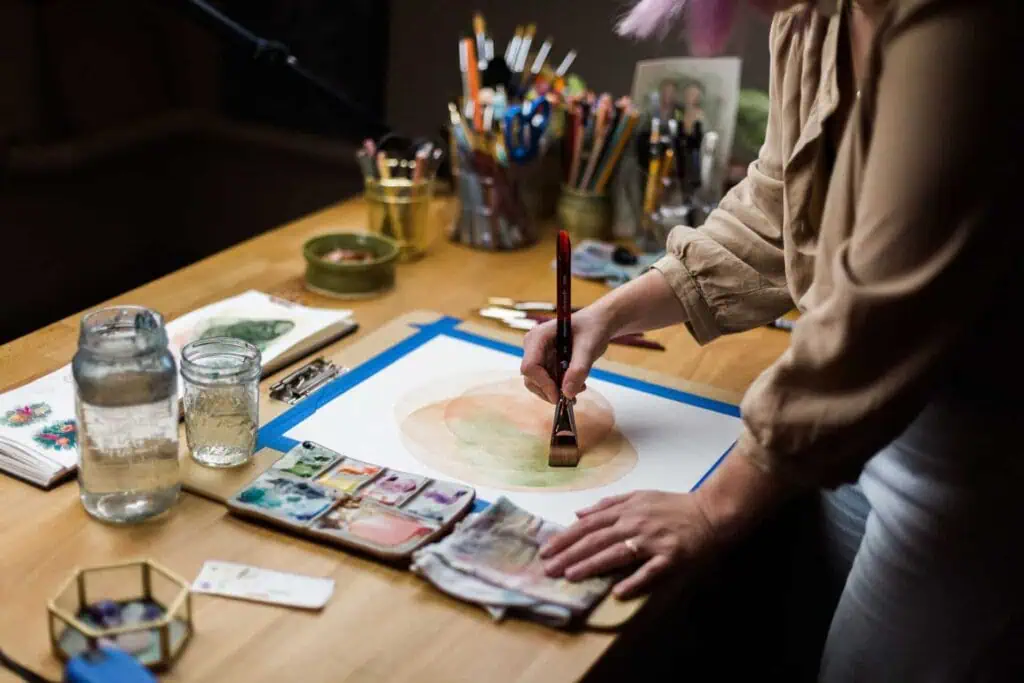
Getting started with watercolor doesn’t require much—or much money! Here are the basic supplies you’ll need to begin painting.
Paper
There are lots of options for paper, so you want to ask yourself a few questions. First, is this a casual painting session where you’re just experimenting, playing, and keeping it loose? Or is this the kind of painting that you want to potentially display as a finished piece?
If you’re just goofing around and keeping the session in the “sketch” zone, consider a mixed media sketchbook. It’s tough enough to handle watercolors, but lower quality (compared to watercolor paper) and typically lower cost.
Then, of course, you have actual watercolor paper, which can be used for “sketching” or more focused work. You’ll want something at least 140lb/300g to experience as little warping as possible.
Watercolor Paints
Your watercolor paints of choice should work unless otherwise specified in the class description. That goes for pan paints, tube paints, liquid watercolors, or more! One thing to note, however, is that watercolor pencils are NOT interchangeable with watercolor paints. They are not bad tools, but they require a totally different approach to how you use them.
Brushes
We recommend that watercolor artists have a small (00-04), medium (05-08), and large (09-16) ROUND brush. Basically, you want something big enough to create large washes, something small enough for fine details, and a medium brush that does everything in between. If you want to have a few more options, getting FLAT brushes in small, medium, and large will also be very useful.
Two Jars of Water
We recommend two containers of water:
– one for cleaning brushes (aka the dirty jar)
– one for wetting your paints (aka the clean jar)
Any containers will do, but many artists like clear glass containers so it is obvious when it’s time for a water change.
Towel
You need a towel or rag so you can dry off your brush and better control your paint-to-water ratio. It’s also handy for cleanups if there’s a spill.
A paper towel will do in a pinch, but we recommend you find cotton rags. Not only are they reusable practically forever, but it’s easy to do this economically. Just go to any thrift store (or rummage in your closet) and grab a white cotton t-shirt; then cut it into rags of your desired size.
Mixing Palette
Finally, you need a space for mixing your paints. This doesn’t need to be an extra item; many watercolor pan sets are designed with a lid that doubles as a mixing palette.
However, if you want an additional palette, all you need is a surface that is nonporous and white (or a very light color) so you can see the colors you’re mixing. A cheap white ceramic or plastic plate would work beautifully.
Conclusion
That’s it! You’re ready to paint. Start with what you have, experiment, and build your collection as you go. Happy painting!
Want to see more in-depth breakdowns of watercolor supplies?
Watch the Watercolor Supplies for Beginners class on Foxsy!



Responses